
Balnakailly WW2 Community Regeneration Project
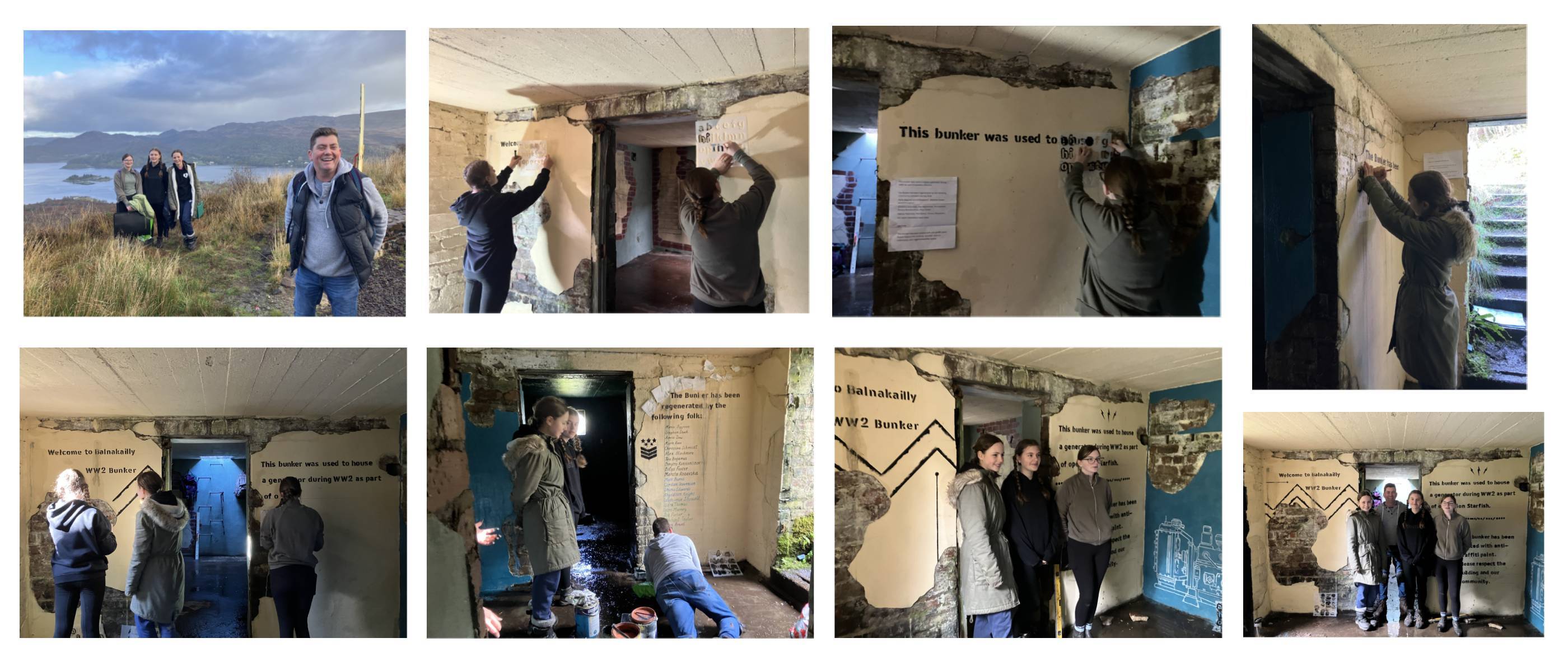
Heritage Coordinate Amie was employed to regenerate and manage Balnakailly Rainforest and it’s built heritage. The Balnakailly WW2 Bunker has historic ignificance and is a destination for community members and visitors. Over the years several fires had been lit in the building, it was a littered, uninviting dark space, defaced and without interpretation. Amie secured funding from the Third Sector Interface Mental Health and Wellbeing Fund for a community project to regenerate the space, she recruited local artists Maria Bygrove and Stephen Doak to design interpretation murals for the bunker walls. Several volunteer sessions were held throughout 2026 in which community members cleaned out the bunker and prepared the walls for murals. Maria and Stephen then hosted several sessions with volunteers to complete the murals. Rothesay Academy pupils designed text interpretation and visited in October 2026 to stencil the text in the entrance room using stencils they made in school. All walls have been treated with anti graffiti paint, acrylic covers have been installed over the holes in the bunker walls, with the exception of the stairwell which has been left open to allow people to climb it. The QR codes in the entrance room take people to this webpage to enable them to find out more about the project; the artists want visitors to experience their own interpretation of the murals, before reading about the context and rationale for them.
Our Project has featured in the Dunoon Observer, you can read the article here:
https://argyllbute24.co.uk/volunteers-transform-historic-balnakailly-bunker-as-community-art-project-takes-shape/

We are a Geocache site! Can you find the Geocache hidden in the Balnakailly Bunker?
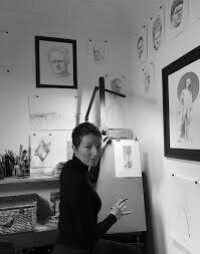
Maria Bygrove is a Rothesay-based artist and printmaker working mainly in ink, graphite and intaglio techniques. With a background in philosophy and graphic design, her drawing-led practice centres on close observation, careful draftsmanship and the discipline of monochrome across still lifes, portraits and
botanical studies.
Website: mmbygrove.com
Email: [email protected]

Stephen Doak is a Bute Based painter and illustrator working from the Port Gallery in Port Bannatyne. Trained at Central School of Art, he works in acylics and paper collage, creating paintings abstracted from landscapes, cityscapes and everyday subjects, alongside his Colin the Sheep drawings, which celebrate the Isle of Bute through a playful local character.
Instagram: Stephendoak59b
Facebook: https://www.facebook.com/profile.php?id=61565175623046
The bunker formed part of a Second World War Starfish decoy site: a place designed to draw enemy bombers away from real communities by creating the illusion of habitation where there was none. The mural follows the same idea of deception, projection and imagination. Its images were chosen because they each deal with the gap between what is there and what is perceived.
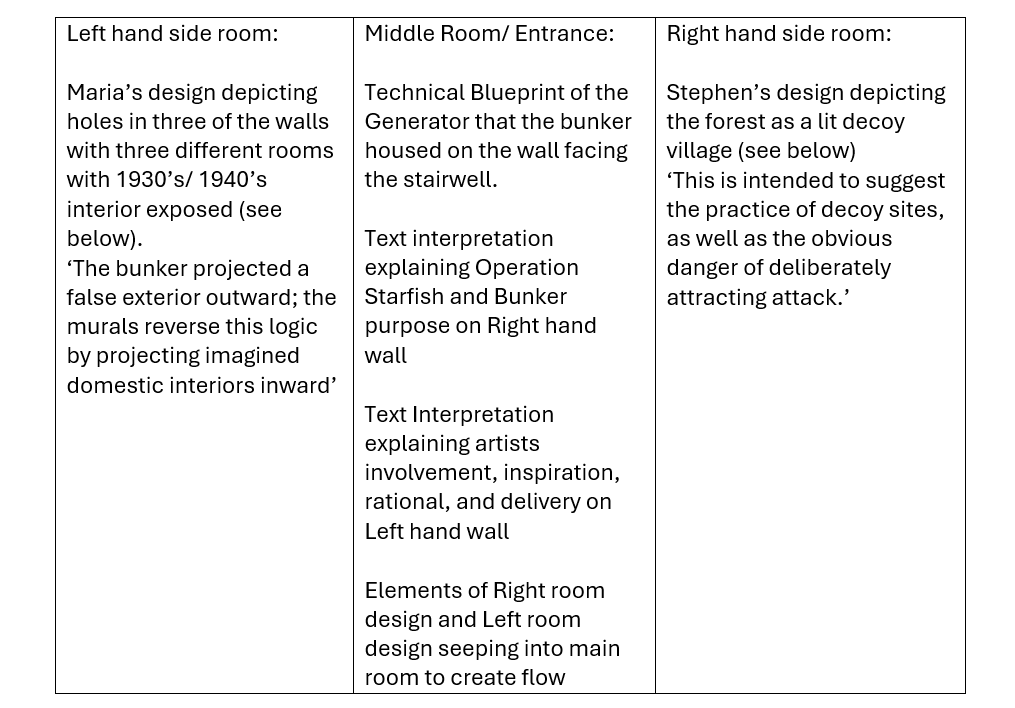
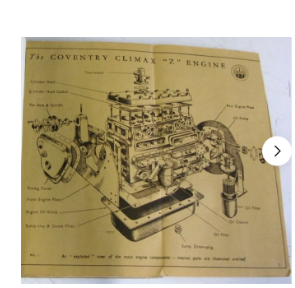
In the central room, the generator blueprint points to the hidden mechanism behind the illusion: a machine capable of turning light into the suggestion of a settlement. In the night forest, scattered lights become signs of life when imagined from the viewpoint of a pilot passing overhead. In the phantom rooms, sketched interiors appear through false openings in the bunker walls, suggesting the homes and lives that the decoy lights asked the mind to invent.
Rather than simply illustrating the bunker’s history, the mural asks visitors to experience the logic behind it. A few signals, lines, lights or traces can be enough to suggest a whole world. The bunker once projected a false world outward; this mural brings imagined worlds back inside.
Maria and Stephen both submitted individual design concepts for the whole bunker.
Maria: (Phantom Rooms - see PDF below)
Stephen: (Art of Deception - see PDF below)
Having met with Amie, they combined both of their ideas into one proposal, which was approved by the
Bute Community Land Company Board.
Entrance/ Middle Room:
Amie appealed for generator make and model information through facebook, and the chair of the British Legion advised that he believes the generator was a Coventry Climax ASM. Chat GPT suggests that Coventry Climax Petrol Engine Generators were used at some of the Operation Starfish sites, and the ASM model fits with the time- period. Amie put in a request for information on the generator, bunker and operation starfish on Bute to the MOD, but they were unable to provide any information. We can assume that this generator or something very similar was housed in the building. Maria kindly researched and generated the blueprint image for the mural in the entrance, it is an artistic reconstruction based on historical reference rather than being 100% accurate.
Left Room:
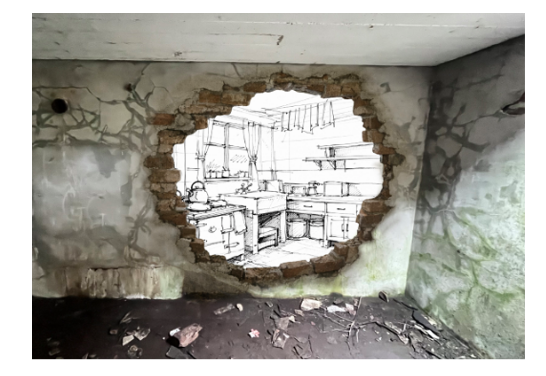
Maria’s Design Concept: Phantom Rooms
Right Room:
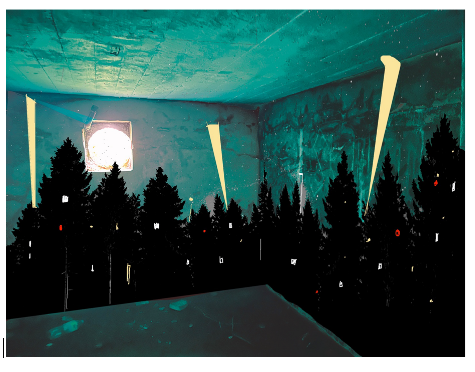
Stephen’s design concept: The Art of Deception
Bunker Project Phase 2 (2027):
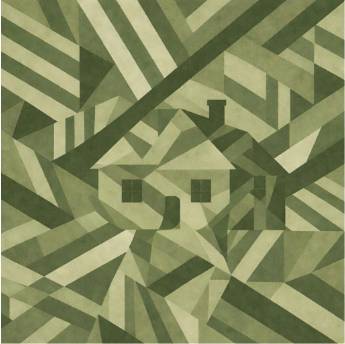
Green-scale Dazzle Camouflage with hidden features on the Bunker external walls
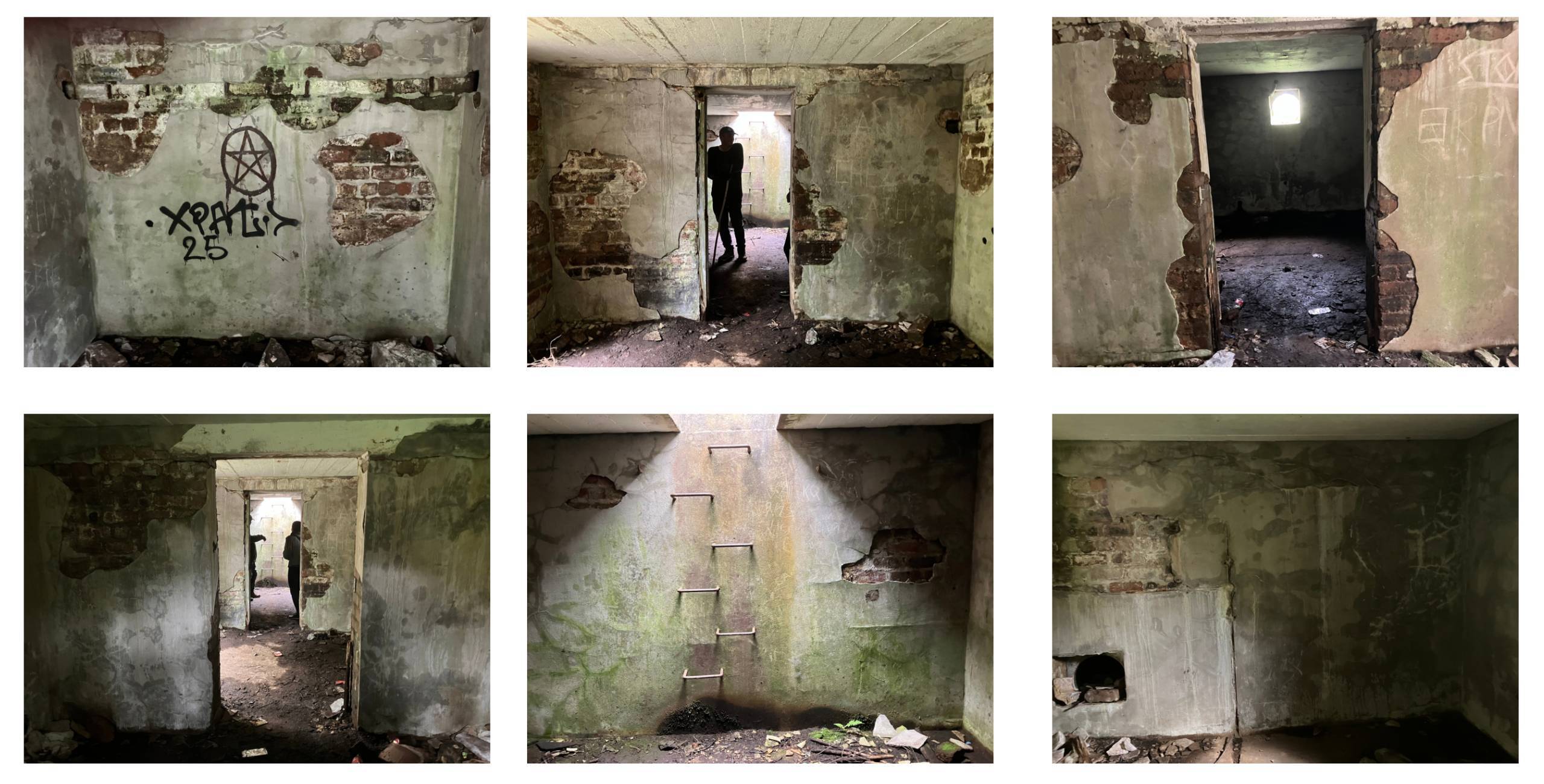
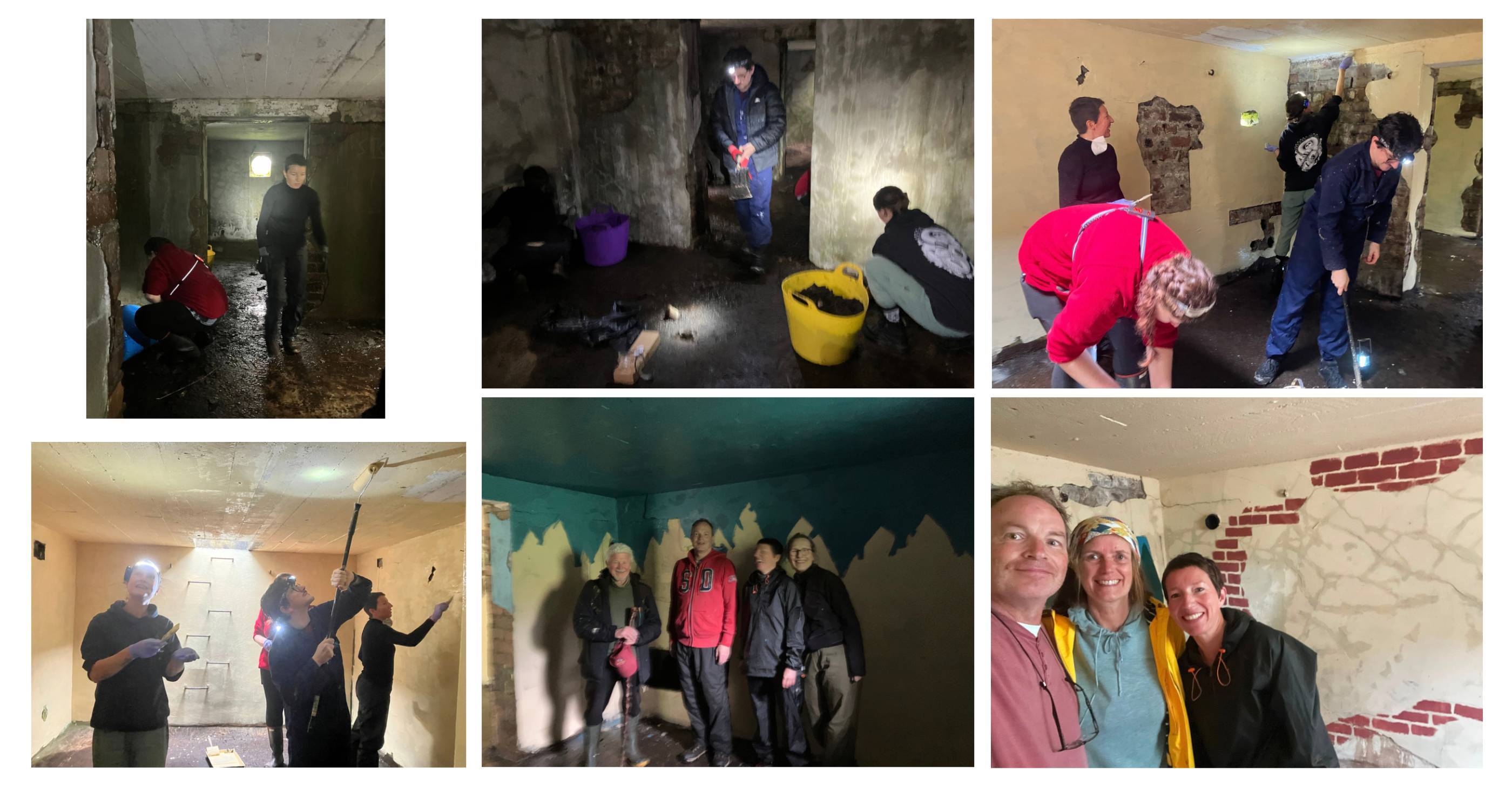
Rothesay Academy pupils Lynsey, Cora and Ameila worked with their Art Teacher Allan Arneil to design and produce stencils. They joined Heritage Coordinator Amie in October 2026 for a session to stencil welcome text in the entrance room at the bunker. The morse code reads 'Operation Starfish'
- Fake City Lights
The Navy set up large wooden frames with fake windows across the local fields. Generators powered rows of dim lights that could be switched on to look like a real town accidentally leaking light through open doors, windows, or tram lines.
2. Decoy Fires
If enemy planes approached, the crew could remotely light large baskets filled with coal, oil, and paraffin. This made it look like the town had already been hit by bombs, tempting the next wave of planes to attack the empty fields.
The site was run by a small team of six to seven Royal Navy sailors who lived down the hill at Rhubodach House. When an air-raid warning came through on their special phone line, they ran up the hill to the command bunker. This bunker was made of thick concrete to protect them from bomb blasts. It even had a hidden vertical escape hatch with iron rungs inside the wall in case the main door became blocked.
Across Britain, Operation Starfish was a massive success that saved thousands of lives. However, the Rhubodach site never actually caught the attention of the enemy. German flight maps showed that their bombers simply didn't fly far enough west over the hills of Bute. Because of this, no bombs ever fell on the Rhubodach decoy village or the nearby woods.
Today, you can still visit the heart of this secret operation. The concrete command bunker has been cleared of overgrown bushes and is kept safe by the Bute Forest Trust. It sits right along the West Island Way and the Balnakailly Loop walking trails. Next to the bunker, you will find a timber visitor shelter and an informational display board. Visitors can even climb onto the flat roof of the bunker to enjoy a peaceful view over the Kyles of Bute viewpoint, a quiet contrast to the secret wartime base it used to be.
Rothesay Academy Pupil / Maths Ambassador Eman Mohammed researched and compiled this information on behalf of Bute Forest in October 2026. She also designed and created her own website which can be viewed here: https://sites.google.com/ab.glow.scot/operation-starfish/home
The main control centre for the decoy village was the Balnakailly Command Bunker, hidden deep inside the woods. While people today usually visit the one main concrete building, the military actually built a small network of three concrete bunkers across the forest to run the site safely.
The main bunker (Balnakailly Bunker) was divided into two rooms:
- The Generator Room
This room held powerful petrol engines. Because the remote forest had no normal electricity in 1941, these generators were needed to power all the fake city lights down in the fields. Thick electrical cables ran out from this room, through trenches in the ground, and directly to the wooden light frames.
2. The Operations Room
This is where the Royal Navy sailors stood watch. Working next to loud engines and explosive fuel was dangerous, so engineers built a vertical escape hatch with iron rungs inside the concrete wall. If a bomb blast or fire blocked the main door, the sailors could climb out through the roof. This room also held the telephone line used to receive air-raid warnings from the mainland.
During the war, the rugged hills and ancient oak trees of Bute Forest provided perfect natural camouflage to hide these secret buildings from enemy planes. The forest was also a very safe choice for a decoy site because it was completely empty. A local farming community called the Balnakailly Settlement used to live there, but it had been abandoned since 1850. Because no civilians lived in the woods by 1941, the military knew that even if German bombs did hit the decoy lights, no innocent people would be hurt.
Since the German pilots missed the decoy completely, Bute Forest was never bombed, and the trees and landscape survived the war untouched. Today, people can still see the moss-covered stone ruins of the old farm before stepping inside the concrete generator rooms to explore Bute's quiet wartime secret.
Rothesay Academy Pupil / Maths Ambassador Eman Mohammed researched and compiled this information on behalf of Bute Forest in October 2026. She also designed and created her own website which can be viewed here: https://sites.google.com/ab.glow.scot/operation-starfish/home
